Monday, 16 December 2013

New and Digital #2

YouTube ad revenues tipped to jump 51% to $5.6bn in 2013

Marketer expects video service to account for 11.1% of parent company Google's ad revenues this year


Google has never revealed revenue figures for YouTube.


Google has never revealed how much money YouTube makes since buying the online video service for $1.65bn in 2006. That doesn't stop analysts and research firms taking guesses.
The latest is eMarketer, which has published its first estimates for YouTube's advertising revenues today. The company predicts that YouTube's gross ad revenues will rise 51.4% to $5.6bn in 2013, accounting for 11.1% of Google's total.

Once YouTube has paid ad partners and video creators their share, its net ad revenues are still expected to reach $1.96bn this year, up 65.5% compared to 2012's $1.18bn.
eMarketer has also broken out YouTube's net ad revenues in the US, estimating that they'll reach $1.08bn in 2013, with $850m of those coming from video advertisements. The company thinks this will give YouTube a 20.5% share of all US video advertising revenues for the year.

"Predicts", "estimates", "thinks" – this is all guesswork, so why should people trust eMarketer's analysis? The company says it is informed guesswork based on "hundreds of datapoints and studies about YouTube revenues, ad impressions, rates, usage and other factors collected from research firms, investment banks, company reports and interviews with industry executives".
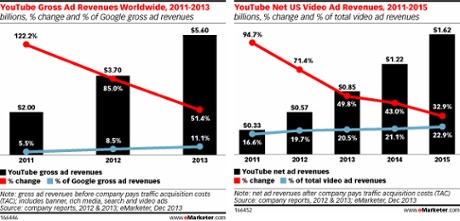

eMarketer's estimates for YouTube's revenue growth.


youtube's ads and revenues are expected to rise so much when this year has ended, The company feels that YouTube's gross ad revenues will rise 51.4% to $5.6billion in 2013 accounting for 11% of googles total. They've paid there ad partners and video creators their share. This shows how popular people in the society believe internet is, as millions of people especially know when they want to listen to a song the first stop they'd go to is youtube. Therefore businesses/companies realise that if they advertise on youtube they'll be able to increase the awareness of what they're advertising to their customers. In return it's a big advantage for YouTube as they are able to receive high revenue for the amount of people who want to advertise on a popular site where majority of the public are immune to going on.


Pareto's Law

1) Pareto's law is also known as the 80/20 rule, the law of the vital few, and the principle of factor sparsity. States that for many events, roughly 80% of the effects come from 20% of the causes.  The rule means that in anything a few 20% are vital and the majority which is 80% are trivial. In Pareto's law it means 20% of the people owned 80% of the wealth. For example, managers know that 20% of the work consume 80% of the time and resources. Therefore, you can apply the 80/20 rule to anything. 

2) 80% of companies profits come from 20% of it' customers. 80% of the media are controlled by 20% of the institutions/companies. And 80% of company's profits come from 20%of customers.  

3) Micorsoft owns both outlook and skype. Google owns android, Google+, youtube and blogger. Yahoo owns tumblr. 

4) Twitter, blogger and tumblr are false at times.They come from people who utter anything, and say whatever they want to which gives people false beliefs.

5) It applys to the content we read online because we are the majority who consume the text. As we are 80% of the people who are reading where as, 20% is owned by the people. 

Monday, 9 December 2013

New and digital media #1

Materialism: 

'Buying more stuff is associated with depression, anxiety and broken relationships. It is socially destructive and self-destructive.'

That they are crass, brash and trashy goes without saying. But there is something in the pictures posted on Rich Kids of Instagram (andhighlighted by the Guardian last week) that inspires more than the usual revulsion towards crude displays of opulence. There is a shadow in these photos – photos of a young man wearing all four of his Rolex watches, a youth posing in front of his helicopter, endless pictures of cars, yachts, shoes, mansions, swimming pools and spoilt white boys throwing gangster poses in private jets – of something worse: something that, after you have seen a few dozen, becomes disorienting, even distressing.
The pictures are, of course, intended to incite envy. They reek instead of desperation. The young men and women seem lost in their designer clothes, dwarfed and dehumanised by their possessions, as if ownership has gone into reverse. A girl's head barely emerges from the haul of Chanel, Dior and Hermes shopping bags she has piled on her vast bed. It's captioned "shoppy shoppy" and "#goldrush", but a photograph whose purpose is to illustrate plenty seems instead to depict a void. She's alone with her bags and her image in the mirror, in a scene that seems saturated with despair.
Perhaps I'm projecting my prejudices. But an impressive body of psychological research seems to support these feelings. It suggests that materialism, a trait that can afflict both rich and poor, and which the researchers define as "a value system that is preoccupied with possessions and the social image they project", is both socially destructive and self-destructive. It smashes the happiness and peace of mind of those who succumb to it. It's associated with anxiety, depression and broken relationships.
There has long been a correlation observed between materialism, a lack of empathy and engagement with others, and unhappiness. But research conducted over the past few years seems to show causation. For example, aseries of studies published in the journal Motivation and Emotion in July showed that as people become more materialistic, their wellbeing (good relationships, autonomy, sense of purpose and the rest) diminishes. As they become less materialistic, it rises.
In one study, the researchers tested a group of 18-year-olds, then re-tested them 12 years later. They were asked to rank the importance of different goals – jobs, money and status on one side, and self-acceptance, fellow feeling and belonging on the other. They were then given a standard diagnostic test to identify mental health problems. At the ages of both 18 and 30, materialistic people were more susceptible to disorders. But if in that period they became less materialistic, they became happier.


The more people become materialistic and buy more things, as in the world today many people are immune and pressurised and see it as a norm to buy designer clothes and shoes etc. 
However, the journal motivation and emotion in July shows that as people become more materialistic and keep consistently upgraded to technology and always buying high quality designer expensive clothes, their well-being which includes relationships, autonomy, sense of purpose and the rest it all falls out of place. As there mind is focussed on the money, and clothes etc they become more immune and find no time for there loved ones. Therefore, the less materialistic they are the happier they become. 

Tuesday, 12 November 2013

Cultivation theory developed by Professor George Gerbner, he began the 'Cultural Indicators' research project in the mid-1960s, to study whether and how watching television may influence viewers' ideas of what the everyday world is like, cultivation theorists argue that television has long-term effects which are significant. In lesson we analysed and closely took a look at the 10 minute video of top boy, looking at the positive aspects of young people and the negative aspects they may be presenting towards the audience. And from these when I identified an aspect from the short clip I would mark a point. As a result altogether, it came to the positive aspects being twenty two and the negative aspect of young people being 25. This evidently shows the audience today how many negative things they may find in the clip and that the world may not be as they seem. Videos like this can create opportunities for youths today to identify how other people live their lives and everything perhaps isn't as it seems from their perspective. The two youths in the clip are represented as caring for each other’s needs and being there for each other as friends, but it shows a stereotypical teen side to them as for an example: when the two young boys go to the supermarket they come across a woman and view them as a ‘sex object’ as they are looking at her in a different way. When the woman goes away they use foul terms and describe her in an inappropriate way, from this specific clip if an adult was watching this they would straight away conclude that all teenage boys are like that which a huge stereotype they would relatively agree with is. Because series like these are broadcasted to a lot to the public where teenage boys are there to entertain people their same age, hence why people today stick to the stereotypical belief that all of the same group are similar. 

Wednesday, 16 October 2013

Yasmin

Does it offer a positive or negative representation of British Muslims? 

To being with the clip Yasmin may start-up with a negative representation of the Muslims that were being presented, for an example when the mosque prayers started at the beginning of the day that's when the morning started for the Muslims. And we were introduced into seeing how they start there day off by looking at the different characters. One of the characters owns a shop and there shutter had graffiti on it which said 'paki go away'. This already significantly shows that they are not accepted of who they are in their community, and they are not wanted there because of being a Muslim. But they didn't respond in an angry manner, they quietly scrubbed the graffiti off. However, there could be a positive as when the morning prayers began it was like a wake-up call for the people in the community and it's positive as it's something different and religious they are being represented as peaceful. Another negative aspect which was represented was the woman Yasmin, when she heard the prayers she took of her hijab and full length clothing and had a top and jeans underneath this is showing she is going into a western lifestyle and choosing to ignore her religious beliefs. However, there is a positive presentation of the woman Yasmin when she is wearing her hijab and scarf and driving the car she get's stopped by the police. Instead of shouting and saying to them why are you stopping me? Is it because I'm Muslim? Why are you being racist? Instead of pointing these things out, she willingly knew what she had to show giving proof of ID, driving licence and informed the police that she didn't consume alcohol. This has a negative representation of the white people as they are the ones who under subtext are being racist, and for example went Yasmin went to the pub she chose to abide by her religion standings and consumed orange juice, but the white people in the pub were staring at her through the facial expressions. Perhaps because they are find it weird or don't want to accept a British Muslim in there community.

To what extent, does it reinforce or challenge Said's theory of orientalism (the difference between east and west) that the west is superior to the exotic or dangerous east?

Orientalism is the difference between east and west, Edward Said who was born in 1935 and passed away in 2003 argued that the west constructed the meaning of the east and it was different, dangerous and uncivilised. Even though he used this theory in the 70s it is more relevant in today's society as the 9/11 bombings took place.  In the clip of Yasmin it reinforces Said's theory as in the first clip we could see the difference between the east and the west. The west don't want to accept the Muslims in their community as they feel they don't or shouldn't belong in their country. This is evident as for an example, in the video on the gates of the Muslim's there was graffiti on the shutter named 'paki' this is showing the difference between the two. However, it seemingly challenges the stereotype of naming the east cast as dangerous as in Yasmin they are seen as peaceful because in the morning the prayers commence and everyone quietly does their work and go do their jobs quietly without making loud noises or causing any trouble. However, the white people in her are depicted as the rude ones by the way they are treating the Muslims for an example, the police stopped Yasmin and questioned her because she's supposedly Muslim but instead of reacting in a rude way and having a go at the police she calmly did what she was told even before the questions began. So this in a way challenges the theory of Said and shows a different side to the west instead of depicting them as a dangerous cast they are shown as peaceful naive people who are being wrongly accused. Blumer and Kats theory (surveillance) we are learning different elements of the religion.

Thursday, 3 October 2013

Personal response: Representation question- Why might some people in the media object to Robin Thicke's song and video for blurred lines?

WWW- good depth, use of theory and wider issues/debates

EBI- look again at McRobbie, would she oppose this video?

LR- consider again how Butler + McRobbie might respond to this video?

Well Butler's views are that traditional feminists are wrong to divide society into 'men' and 'women' and says gender is not biologically fixed. He believes that by dividing men and women, feminists accidently reinforced the idea of differences between the two genders.He says that male and female behaviour is socially constructed rather than the result of biology. Therefore in response to Robin's song and video of Blurred lines I believe he would be strongly against, as it's representing as females being some sort of dolls and they are allowing men to control them. The men have a higher authority in this video, as they are wearing suits but the women are depicted as the lower ones because they are either naked or wearing very little clothes.This is therefore how the behaviour is being constructed. And people view this as the same, because men are stereotypically head of the house and the bread winners, whereas the females are the housewives and have to listen to the men. This is showing that men, dominate over women and society are the ones that are depicting the difference between men and women therefore Butler would be against this video.
McRobbie highlights the empowering nature of magazines such as cosmopolitan and glamour, taking a different perspective to traditional feminists.

Post-colonialism

The daily mail states that "it was an unpleasant mix of contempt, misanthropy and thinly disguised racism". In the opening ceremony this was supposed to be a representation of how the current generation is now but as the organisers found an educated white middle-aged mother and black father living together with a happy family they thought this was a set-up. Colonialism was a period of history in the 15th centuries when people declared that there land was their, they had power and made money from the national resources.Post-colonialism is what has happened since the 1950 empire, that now Britain is a multi-cultural country. In the last 60 years people from around the world have been coming here as refugees or to stay in a safer country, we are as multi-cultural as we'll ever be in the societies but some still view that Britain was how it was 60 years ago. Because for an example, if a white British was to travel abroad to a place like India they would be treated with a lot of respect and have a higher status. They'd be invited to big luxury restaurants and hotels ect. Therefore, not many people still consider Britain as being 'equal'. Therefore, when it comes to the Olympic opening ceremony the media such as the daily mail was against this and really conclude that this is not how the multi-cultural society is depicted today. For an example, the theorists Alvarado (1987) stated the key themes in racial representation about black people.
Exotic- traditional clothes, carnivals. Dangerous- gangs, drugs. Humorous- comedians, sidekicks. The one I found interesting was Pitied where in the Comic Relief white people help the black people in places like Afria who are stuck in poverty. This is not a set-up as it's celebrities and white people who are making a show and donating as much money possible to help the people in need. Moreover, as we are living in a multi-cultural society this allows different cultures to mix in very well and usually different races tend to get married. There are happy black and white people living together today, just because it's depicted in the media as different doesn't mean realistically it doesn't happen. We don't live in the past, but in the presence.